MER vs ROAS: the one number beauty founders should watch
Platform ROAS tells you what each ad platform claims. MER tells you what your business actually earned. Here is how to use both.

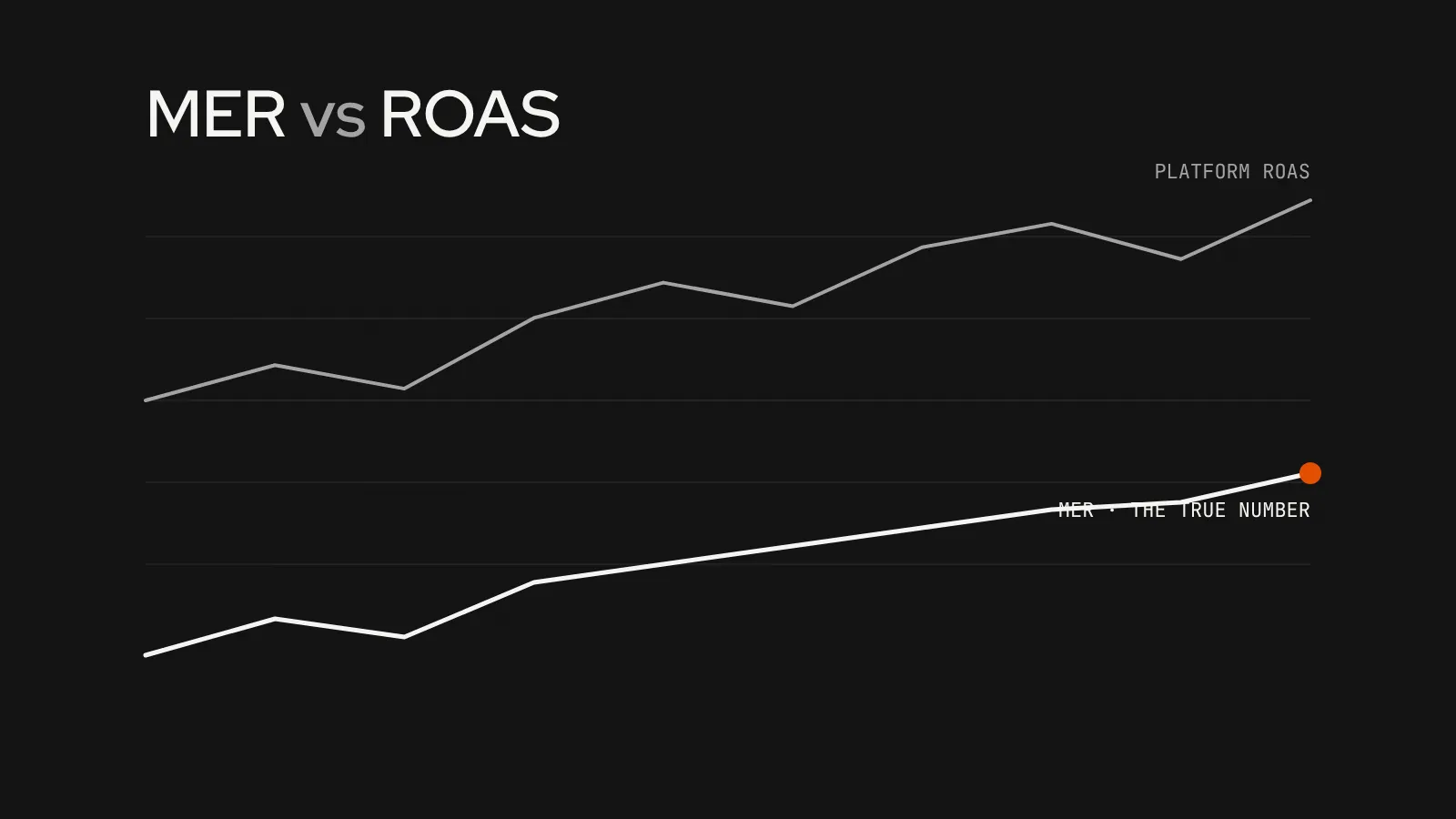
Every ad platform reports its own return on ad spend (ROAS). Add them up and they often claim more revenue than your store actually made. That is not a bug; each platform counts the sales it touched, and many sales were touched by more than one.
What MER measures
MER (marketing efficiency ratio) is total revenue divided by total ad spend, across every channel, for the same period. It can’t be double counted, because it comes from your store’s real revenue.
If you made $120,000 last month and spent $40,000 on ads in total, your MER is 3.0.
Why founders should watch MER first
- It matches your bank account, not a platform dashboard.
- It shows whether growth is profitable as a whole.
- It is simple enough to read every Monday.
Where ROAS still helps
Platform ROAS is useful inside a platform, to compare one campaign or ad with another. Use it for decisions within a channel, and MER for decisions about the business.
Know your break-even
MER only means something next to your margin. If your gross margin after shipping and fees is 60%, your break-even MER is roughly 1.7 (1 ÷ 0.6). Above it, ads are paying for themselves on the first order; below it, you rely on repeat orders to make a profit.
Add new-customer numbers
Total MER can look healthy while you mostly sell to existing customers. Track cost per new customer alongside it, so you know acquisition is working too.
In our weekly report, profit after ad spend sits at the bottom as the one true number, with MER and cost per new customer above it.
// Your next step
Want this applied to your brand?
Book a 30-minute growth audit call. You leave with 3 written fixes, whether we work together or not.
Book a growth audit call